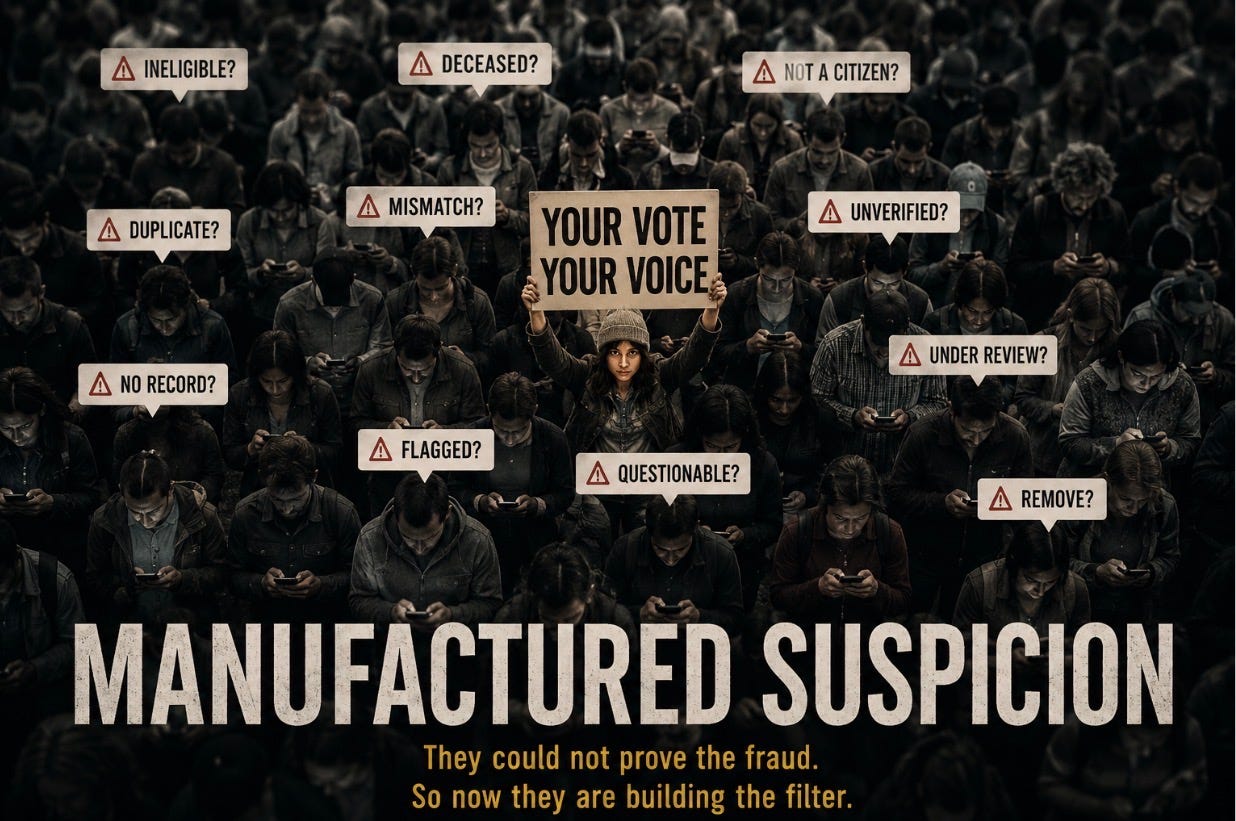
MANUFACTURED SUSPICION

By Steven J. Boardman
The fraud they could never prove has become the filter they are now trying to build.
That is the operation. Not the slogan. Not the press release. Not the patriotic bunting stapled to the podium while some dead-eyed functionary explains that democracy is safest when fewer people can use it. The operation is simpler and uglier than that. They spent years telling America that its elections were crawling with illegal voters, dead voters, phantom voters, duplicate voters, mystery vans, hacked machines, bamboo ballots, foreign software, Italian satellites, Venezuelan ghosts, and whatever else the fever swamp coughed up after midnight between pillow commercials. The accusation was everywhere. The evidence was not.
They searched for it. They sued over it. They audited for it. They dragged it through hearings, affidavits, press conferences, documentaries, podcasts, rallies, fundraising emails, and lawsuits. They brought it into courtrooms, which was unfortunate for them, because courtrooms have a nasty old habit of asking whether a claim has brought anything more durable than vibes in a rented suit.
It had not.
That was the problem. The lie could survive cable television. It could survive Facebook. It could survive a rally, where the normal standards of evidence go to die in a merch tent. It could survive the mouth of a man whose entire political career has been one long attempt to turn repetition into proof. It could survive a thousand people shouting “Stop the Steal” with the intellectual confidence of a raccoon trapped in a vending machine. What it could not survive was a judge asking, in effect, “Wonderful. Where is the evidence?”
So now the lie has changed clothes.
When an accusation fails as evidence, the next move is to convert it into procedure. When mass fraud cannot be proven, the state can still manufacture mass suspicion. That is the cleaner version of the same project. It does not require a sweating lawyer in a landscaping company parking lot. It does not require a television surrogate waving a folder full of rumor like Moses descending from Mount Facebook. It simply requires databases, deadlines, bureaucratic fog, federal pressure, state compliance, and enough public confusion to make disenfranchisement sound like housekeeping.
According to Associated Press reporting, the Trump administration has run at least 67 million voter registrations through the Department of Homeland Security’s SAVE program, flagging about 24,000 potential noncitizens and roughly 384,000 people as potentially deceased when federal and North Carolina figures are combined. Those words matter. Potential. Potentially. Flagged. Checked. Reviewed. This is not the vocabulary of proven fraud. It is the vocabulary of administrative suspicion, and suspicion is precisely what you manufacture when the evidence refuses to appear on command.
Now set that number beside the actual documented scale of the problem it is supposed to be solving.
The Brennan Center found 30 suspected noncitizen voters out of 23.5 million ballots cast across 42 jurisdictions after 2016. The Heritage Foundation’s own Election Fraud Database, maintained by people who would be delighted to find an army of illegal voters, turned up 77 confirmed noncitizen ballots cast across the entire country over a 24-year period from 1999 to 2023. That is not a typo. Seventy-seven. In 24 years. Across the whole United States. Post-election audits of the 2024 race confirmed the pattern: Michigan found 15 suspected noncitizen voters out of 5.7 million ballots. Iowa found 35 confirmed noncitizen votes out of more than 1.6 million. Wyoming launched an investigation after 13 voters were flagged for citizenship issues. Every single one turned out to be a legal, eligible voter.
Even the government’s own immigration apparatus has acknowledged the obvious: noncitizen voting is exceptionally rare, and existing penalties already make it a brutal gamble for any noncitizen foolish enough to try it.
Then the administration built a machine to fix it anyway.
They ran 67 million registrations through SAVE to chase a problem that, when actually documented, produces numbers you could fit in a school van. The disproportion is not an accident. It is the argument. You do not build a national suspicion apparatus to catch scattered cases over two decades. You build it to make suspicion itself the point.
A database flag is not a conviction. A mismatch is not a crime. A stale record is not a conspiracy. A clerical error is not treason. Yet once the machinery is built, the burden begins to move. The state raises the question, and the citizen has to answer it. The government creates the doubt, and the voter has to cure it. A person who was registered yesterday can become suspicious today because some system, somewhere, coughed up a match and handed it to officials who have every political incentive to treat the cough as a diagnosis.
This is how the modern version works. It does not arrive wearing a hood. It does not need dogs, firehoses, or a sheriff with a drawl and a conscience made of wet cardboard. It arrives in a letter. It hides in a deadline. It speaks in the bored tone of a clerk. It says there has been an issue with your registration. It says additional documentation may be required. It says your eligibility is under review. It says the process is routine. It says there is nothing to worry about if everything is in order.
That last phrase should chill the blood.
“Nothing to worry about if everything is in order” is the lullaby of every system that has ever placed the burden of innocence on the individual. Of course eligible voters have nothing to fear. Of course innocent people have nothing to fear from searches. Of course lawful citizens have nothing to fear from surveillance. Of course the wrongly accused have nothing to fear from interrogation. Of course the person mistakenly removed from the rolls can simply fix it, assuming they receive the notice, open the notice, understand the notice, have the documents, have the time, have the transportation, have the money, have the language access, have the legal help, and discover the problem before Election Day instead of while standing in line with a job, a child, a bad hip, a limited lunch break, and a government-issued document proving they are the person the government is currently treating as suspicious.
That is where the con becomes visible. The people selling this as “election integrity” recognize only one kind of harm: an illegal vote being cast. They treat that possibility as a national emergency even when the evidence is microscopic. The other harm, the lawful voter being blocked, purged, challenged, suspended, intimidated, confused, or buried under paperwork, barely exists in their moral universe. It is treated as a clerical inconvenience, a regrettable edge case, a little administrative splatter on the windshield of democracy.
The right to vote is not less violated because the weapon was a spreadsheet.
The AP’s reporting already contains the warning sign that should stop honest people cold. Anthony Nel, a 29-year-old naturalized citizen in Texas, was flagged as a potential noncitizen after Texas ran its voter file through the DHS system. His local election office temporarily canceled his registration while he was waiting for a new passport to replace an expired one. Read that again slowly. A citizen was not asking the government to create a right. He already had the right. The machine blinked, and he had to claw his way back into it.
This is not paranoia. This is the thing doing the thing.
The same AP report describes Domingo Garcia, a Dallas lawyer and voting rights activist who says he has voted regularly for 50 years, most recently in the March 3 primary, and whose registration was recently canceled without explanation. He suspects officials concluded he was dead. There is a certain dark comedy in having to inform the state that you are alive enough to object to being politically buried, but the joke curdles quickly. A citizen should not have to rise from the administrative grave to cast a ballot.
Now consider the architecture being built around cases like these.
In Ohio, a new law requires local election boards to “promptly” cancel registrations that the secretary of state identifies as noncitizens during checks that occur at least monthly. The secretary’s own election manual gives counties five business days to complete the cancellations. The notice to the voter arrives after the fact. A person whose registration is canceled can submit a provisional ballot and then has four days after Election Day to provide proof of citizenship, assuming they discover what happened before they show up at the polls and find their name missing. Voting rights groups are suing the state, arguing the law relies on databases proven to contain outdated citizenship data and that the cancellations violate federal law by proceeding without adequate notice. The ACLU’s Freda Levenson summarized Ohio’s approach with admirable economy: “Shoot first and ask questions later.”
Exactly.
The gun is paperwork. The bullet is doubt. The wound is civic. And in Ohio, they mailed the notice after they pulled the trigger.
The defenders will say this is merely a first step. SAVE does not automatically prove a person is ineligible, they will say. It only identifies registrations for further review. That sounds comforting until you remember that “further review” is not an abstraction. It has a calendar. It has a deadline. It has a mailbox. It has a voter with a life.
Here is the thing they will not say: the National Voter Registration Act already requires states to maintain accurate voter rolls. That federal law has existed since 1993. It mandates individual notices, waiting periods before removal, protections against purging voters simply for not voting recently, and a hard rule that systematic purges must be completed at least 90 days before a federal election. If the goal were accurate rolls, that framework already exists. If the goal were accuracy, the administration would have published error rates for the 67 million records it ran through SAVE before a single voter was removed. It did not. A system built for accuracy measures its mistakes in public. A system built for suspicion moves fast and apologizes, if at all, in the dialect of process.
And notice the asymmetry. If the state wrongfully treats you as suspicious, the burden falls on you. If the state is wrong, it apologizes later, assuming it apologizes at all. If you are wrong about your own eligibility, you lose your vote. The bureaucracy gets margins of error. The citizen gets a deadline. The machine gets deference. The voter gets homework.
The officials get to say they are protecting democracy while democracy stands outside the office holding three forms of identification and a letter it almost threw away as junk mail.
Now place that machinery over tens of millions of registrations. Place it in states controlled by officials who have spent years feeding the public a diet of election-fraud mythology. Place it in the months before a midterm election. Place it beside a president who already tried to overturn an election he lost. Place it beside a party apparatus that has trained its voters to believe every defeat is suspicious unless Republicans win. Then add this: the margin in competitive Senate races and swing districts is often measured in hundreds or low thousands of votes. A suppression tool does not need to disenfranchise millions to determine an election. It needs to disenfranchise enough. Precision is the feature, not the flaw.
At some point, even the most committed toddler in the republic has to stop pretending the applesauce got on the wall by itself.
ProPublica’s reporting sharpens the point. When Trump tried to overturn the 2020 election, many of the guardrails held because actual human beings inside the system refused to bend. ProPublica identified at least 75 people across federal agencies involved in safeguarding the 2020 vote. Nearly all of them are now gone, having resigned, been fired, or been reassigned, especially in the departments of Justice and Homeland Security. They have been replaced by roughly two dozen Trump-installed officials in positions that could affect elections, including ten who actively worked to reverse the 2020 vote.
Institutions do not defend themselves by magic. They are not enchanted furniture. They depend on people willing to say no when power demands obedience. Replace enough of those people with loyalists, zealots, opportunists, and careerists who know which way the wind is blowing, and the same system that once resisted pressure can begin transmitting it.
That is the quiet horror of this moment. The next attack on democracy does not need to look like January 6. It does not need fur hats, smashed windows, bear spray, gallows, or some man in tactical cosplay screaming about freedom while stealing office furniture. The next attack can look like an eligibility review. It can look like a memo. It can look like a state compliance notice. It can look like a list of voters who need to be checked. It can look like an official saying, with the serene dishonesty of a man laundering power through process, that everyone should support clean elections.
Fine. Let us have clean elections.
Let us have voter-roll maintenance so transparent that every error can be measured, every data source can be challenged, every eligible voter can cure a mistake, and every official who wrongly removes a citizen from the rolls can be held to account. Let us demand the same urgency for wrongful disenfranchisement that these people reserve for imaginary armies of illegal voters lurking behind every precinct table like extras in a low-budget authoritarian bedtime story. Let us publish the accuracy rates before the first voter is canceled. Let us make the cure period generous, the notice unmistakable, the courts available, and the penalty serious when an eligible citizen is wrongly stripped of a right they already had.
Watch how quickly the patriots lose interest.
The defenders will ask why anyone is afraid of election integrity. That question is the smirk. Nobody is afraid of integrity. People are afraid of the obvious scam in which the same movement that could not prove mass fraud now wants power over mass eligibility review. People are afraid of a government that manufactures doubt, shortens the path from doubt to removal, and then pretends the resulting purge is just the cost of keeping things tidy. People are afraid because American history is full of neutral-sounding rules that somehow landed with remarkable precision on the same communities every time.
Literacy tests were neutral on paper. Poll taxes were neutral on paper. Grandfather clauses were written in legal language. Purges have always had forms. Suppression rarely introduces itself as suppression. It prefers order, standards, qualifications, maintenance, verification, and concern. It prefers a vocabulary respectable enough to let cowards participate without admitting what they are doing.
The Supreme Court belongs in this story too, because the legal architecture has been moving in this direction for years. The conservative legal project has weakened federal voting-rights protections, narrowed civil-rights enforcement, empowered state restrictions, and treated old suppression mechanisms as if they were relics rather than habits with better manners. This administration adds something more openly dangerous to that landscape: executive pressure, federal data systems, election-denial personnel, and a movement that has already demonstrated its willingness to treat democratic loss as an administrative problem to be solved.
This is why the matter cannot be discussed as a normal voter-roll maintenance dispute. A normal administration does not spend years inventing a fraud crisis, fail to prove it across more than 60 federal and state court fights, then ask to be trusted with a national suspicion machine. A normal political movement does not pressure state officials to “find” votes, watch its theories collapse before judges appointed by both parties, then return to the same arena with databases and proof-of-citizenship schemes. A normal president does not attempt to overturn an election, replace the people who stopped him, and then ask the public to assume good faith when he starts reshaping the machinery of the next one.
This is pattern recognition, not paranoia.
That is why the phrase matters.
Manufactured suspicion.
Remember it.
It is not merely a mood. It is a method. It is the conversion of a failed accusation into an administrative weapon. It is what happens when a movement cannot prove that the electorate is corrupt, so it teaches the state to treat the electorate as suspect. It is the politics of “maybe” deployed against the rights of actual people. Maybe you are not a citizen. Maybe you are dead. Maybe your record does not match. Maybe the letter arrived. Maybe you saw it in time. Maybe your ballot will count. Maybe democracy is still yours, provided you can survive the obstacle course designed by people who benefit when you do not.
The next stage will not always look like a mob at the Capitol. Sometimes it will look like a database match. Sometimes it will look like a white envelope mistaken for junk mail. Sometimes it will look like a deadline missed by someone who never knew the clock had started.
They could not prove the fraud.
So now they are building the filter.
Sources: Associated Press (DHS SAVE checks, voter-registration flags, Anthony Nel, Domingo Garcia, Texas review procedures, Ohio cancellation procedures, ACLU response); ProPublica (Trump-installed election officials, 2020-era guardrails, officials connected to efforts to reverse the 2020 vote); Brennan Center for Justice (noncitizen voting data, 2016 post-election review); Bipartisan Policy Center (Heritage Foundation Election Fraud Database analysis, 77 confirmed noncitizen ballots 1999-2023); Democracy Docket and AP reporting on 2024 state audits; Fair Elections Center (USCIS acknowledgment); Ohio Capital Journal (Ohio S.B. 293, five-day cancellation window, post-facto notice); Signal Ohio (monthly SAVE checks, 25 states, 60 million registrations reviewed).