Project: Middle East

Part One of Four: How Two Men in a Room Built a Region, Then Broke It
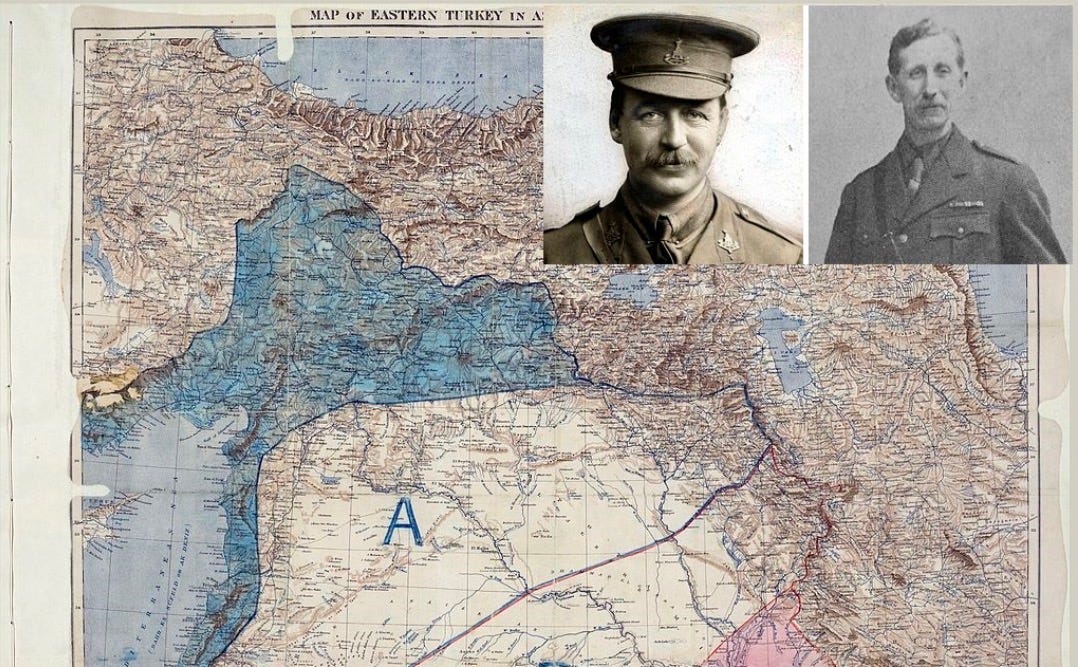
By Steven J. Boardman | substack.com/@stevenboardman
The Middle East is one of the most successful acts of political labeling in modern history. The phrase sounds ancient now, as though it describes something stable and self-evident, some enduring piece of the earth with a natural coherence all its own. It does not. It was coined from outside, imposed from above, and organized around imperial perspective. The people living in Beirut, Baghdad, Damascus, Jerusalem, and Basra did not gather to decide that they inhabited the “middle” of anything. The name came from the strategic imagination of empires that wanted the region rendered legible for management.
The term entered geopolitical vocabulary in 1902 through Alfred Thayer Mahan, an American naval officer thinking in terms of trade routes, naval power, and imperial chokepoints. The British embraced it because it suited a world arranged in relation to Europe: Near East, Middle East, Far East. Those labels revealed the arrogance of the order that produced them. They sorted the world by distance from the imperial center and pretended the arrangement was descriptive. It was administrative. It took a vast and varied human landscape and turned it into strategic space.
That naming mattered because it prepared the ground for everything that followed. Once a region is reduced to a problem of routes, influence, and access, the people inside it begin to disappear behind the map. Their histories remain. Their identities remain. Their loyalties remain. What changes is the lens through which power sees them. They become populations to be distributed, rivals to be balanced, clients to be cultivated, and territory to be organized in the service of interests formed elsewhere.
That is the buried first chapter of the story. The violence came later. The abstraction came first.
In May 1916, while the First World War was still consuming Europe and the Ottoman Empire was beginning to fracture under its pressure, Sir Mark Sykes of Britain and François Georges-Picot of France met in secret to discuss the future of Ottoman Arab lands. They were not men of the region. They represented powers already imagining the postwar settlement before the war itself had ended. What they produced was an agreement dividing large parts of the Arab provinces of the Ottoman Empire into zones of British and French control and influence. Lebanon and Syria would fall into the French sphere. Iraq and Palestine would fall into the British. Russia was to receive its own share until revolution rearranged the bargain.
The offense of Sykes-Picot went beyond imperial cartography, offensive though that was. Britain was making other promises at the same time. It had been encouraging the Arab Revolt through its correspondence with Sharif Hussein of Mecca, implying that Arab independence would follow Ottoman defeat. Hussein and his sons supplied revolt, manpower, and legitimacy. London supplied ambiguity, flattery, and, eventually, betrayal. When the Bolsheviks published the secret agreement in 1917, the Arabs learned what had been arranged behind their backs. They had been invited into one story while Britain and France wrote another.
That betrayal was not accidental. It was built into the method.
Sykes-Picot was only one strand of British wartime duplicity. In November 1917, Foreign Secretary Arthur Balfour sent his now-famous declaration to Lord Rothschild, announcing support for the establishment in Palestine of a national home for the Jewish people. Arabs made up roughly 90 percent of Palestine’s population at the time. The declaration promised that nothing should prejudice the civil and religious rights of the “existing non-Jewish communities” already living there. The phrase remains astonishing for its bluntness. The overwhelming majority of the population was acknowledged only indirectly, defined by absence rather than identity. Their civil and religious rights were named. Their political rights were not.
By then Britain had effectively issued three incompatible commitments touching the same land. It had encouraged Arab independence. It had privately agreed to divide Arab territories with France and Russia. It had pledged support for a Jewish national home in Palestine. These were not tragic slips made in wartime confusion. They were instruments of leverage deployed by an imperial power pursuing victory and postwar advantage. The contradictions were visible at the time. The people making policy understood them. They chose utility over coherence because utility was the point.
Then came Cairo.
In March 1921, Winston Churchill assembled British officials in Cairo to settle the future of Britain’s new imperial holdings in the Arab East. He referred to them as his “forty thieves,” which was, in its own way, a neat summary of the enterprise. For ten days, British functionaries sat in the Semiramis Hotel deciding the future of peoples who were not represented in the room. Iraq was assembled by binding together Sunni Arab, Shiite Arab, and Kurdish populations under a monarchy imported from the Arabian Peninsula. Transjordan was created. British thinking on Palestine was refined and consolidated. A map was being hardened into government.
Churchill himself understood the instability of what was being attempted. He admitted that the situation filled him with anxiety and that armed tensions between Arabs and Jews were likely to worsen. He moved forward anyway. That matters because it destroys one of imperial history’s favorite alibis. These men were not innocents overtaken by complexity. They often knew perfectly well that the arrangements they were imposing were brittle, contradictory, and likely to produce long-term unrest. They proceeded because an unstable order under imperial supervision was preferable to any local order they could not direct.
The Kurds offer one of the clearest examples. They had briefly been offered the prospect of a homeland under the Treaty of Sèvres in 1920. By the Treaty of Lausanne in 1923, that prospect had disappeared. Once Turkish military realities made the earlier promise inconvenient, the promise was discarded. Kurdish populations were left divided across what would become Turkey, Iraq, Syria, and Iran. One people became several minorities because stronger states decided that was more useful.
This is how much of the modern region was built. It did not emerge through a broad flowering of self-determination. It was organized through strategic settlements in which imperial convenience consistently outranked local consent.
There is another misunderstanding that still clutters Western thinking about the region. Colonial and later Western narratives often treat “the Arabs” as though they were already functioning everywhere as a single unified political nation waiting only to be recognized. The reality was more complicated. Arab identity was real as a linguistic and cultural category, and Arab nationalist thought was indeed developing under late Ottoman rule. But political and social life for many ordinary people still moved through other structures with greater immediacy: tribe, city, confession, lineage, region, family, and local custom. A Damascene knew Damascus. A man from the Hejaz knew the Hejaz. A Bedouin of a specific confederation understood his obligations, routes, alliances, and rivalries in ways far more concrete than any future national border would ever be.
That does not mean there was no Arab consciousness. It means the lived reality on the ground was denser and more layered than the categories European administrators preferred. Imperial power flattened that complexity because flattened people are easier to file, count, and rearrange.
The desert provides one of the best examples of how badly outsiders misunderstood the order before them. European administrators often looked at tribal movement and saw emptiness, lawlessness, or at best a primitive social form waiting to be domesticated by the state. In fact, Bedouin life operated within longstanding systems of customary authority. Seasonal movement, grazing rights, access to water, tribal obligations, and negotiated passage were all regulated according to rules that had evolved over generations. The land was not empty. It was governed in forms the colonial state neither respected nor recognized.
When imperial borders arrived, they cut through these older realities without replacing them cleanly. Colonial records are full of frustration on this point. People continued to move, graze, trade, and negotiate space as they had before. A line on a European map did not instantly reorder daily life. Yet the new states, and the powers supervising them, could not tolerate rival systems of movement and authority forever. In Mandate Palestine, the British eventually imposed the Bedouin Control Ordinance in 1942, empowering officials to tell Bedouin communities where they might go, where they might not go, and where they must remain. In Syria, the French confronted rural and tribal resistance with coercion. What had once been organized through custom became subject to state discipline.
These developments mattered because the later identities hardened into sectarian and national categories were not simply waiting in pure form to be recognized. They were institutionalized within political structures built under mandate rule. In many cases the states came first and the nation was expected to arrive afterward. Lebanon is among the clearest examples of what that produced.
France did not discover Lebanon. It built Greater Lebanon by expanding the old autonomous district of Mount Lebanon into something larger and more politically precarious. Mount Lebanon itself had long possessed a distinctive character, with a strong Maronite Christian presence and deep ties to French patronage. But the French mandate enlarged it to include Beirut, the Bekaa Valley, the southern coast, Tripoli, Sidon, Tyre, and surrounding territories. The new state was more economically viable than Mount Lebanon alone would have been. It was also far more unstable as a political arrangement because it enclosed substantial Sunni, Shiite, Druze, and other populations within a framework that did not rest on a shared national vision.
That enlargement shaped everything that followed. The mandate authorities did not set out to cultivate a durable civic republic in which citizens would gradually supersede sectarian identity. They governed through sectarian structures and preserved communal difference as a political principle. Independence did not erase that design. It inherited it.
The National Pact of 1943 formalized the confessional distribution of power that would define Lebanese political life for generations. The presidency went to a Maronite Christian. The premiership went to a Sunni Muslim. The speakership of parliament went to a Shiite Muslim. Political office was not organized around equal citizenship but around communal allocation. The system did not abolish sectarian identity. It made sectarian identity the grammar of the state.
Even its demographic foundation was unstable. The distribution of offices and representation relied on the 1932 census, the last official census Lebanon would ever conduct. Scholars have long argued that the count favored Maronite interests, including through its treatment of emigrant populations. The larger fact is simpler and more devastating: no government has dared hold a new census since. A fresh count would risk forcing the political class to confront demographic realities that might threaten the entire confessional arrangement on which its power depends. Lebanon has been governed for decades through a colonial-era demographic snapshot that its ruling elites have been too frightened or too self-interested to update.
What emerged under these conditions was not a strong republic but a cartel of sectarian intermediaries, the zu’ama, who distributed favors, jobs, protection, and access through communal networks. Citizens did not meet the state as citizens. They met brokers. Political life moved through patrons, not institutions. The state functioned less as a universal public authority than as a contested mechanism for the allocation of spoils among sectarian elites.
Such a system protects itself by keeping public life weak. A strong civic state would reduce the need for patrons. It would create direct obligations between institutions and citizens. It would make sectarian brokerage less central. Lebanon developed in the opposite direction. Its communities were formally recognized and politically balanced, but the country was denied the institutional evolution through which those communities might gradually have become participants in something more cohesive than a permanently negotiated communal order.
The celebrated sophistication of Beirut concealed these weaknesses for a time. There was glamour. There was finance. There was culture. There was cosmopolitan life. There was also chronic inequality, uneven development, and a state whose benefits were distributed through networks of patronage rather than through strong public institutions. Shiite communities in the south and in parts of the Bekaa were especially neglected. That neglect would become one of the decisive facts of modern Lebanese history.
Then the Palestinian armed presence intensified the strain.
Palestinian refugees had already entered Lebanon in large numbers after 1948. The shift after Black September in 1970 was different in scale and political consequence. After the PLO was expelled from Jordan, major Palestinian armed factions relocated to Lebanon, particularly in the south. That development brought Lebanon’s internal balance under new pressure. Many Lebanese Muslims and leftist groups saw the Palestinian cause as aligned with their own dissatisfaction with the old confessional order. Many Lebanese Christians, especially on the right, saw the armed Palestinian presence as a direct threat to the state and to the political equilibrium from which they benefited.
By 1975 the Lebanese system cracked. The conflict that followed cannot be reduced to a neat single label. It was a civil war, but that phrase alone is too small. It was also a militia war, a sectarian war, a class war, a struggle over the Palestinian armed presence, and a regional proxy war layered onto one another. Syria intervened in 1976. Israel invaded in 1978 and again on a far larger scale in 1982. Militias multiplied. Alliances shifted. Violence hardened. More than 150,000 people were killed, and close to a million were displaced. Lebanon ceased to function as a coherent state and became an arena in which its internal fractures and its neighbors’ ambitions fed each other.
The 1982 Israeli invasion became one of the decisive turning points. Israel’s stated goal was to drive out the PLO and reshape the Lebanese political environment in its favor. It succeeded in expelling PLO leadership from Beirut. It also helped create the conditions for the rise of a new force that would outlast the occupation and define the next era of Lebanese history. Hezbollah emerged from the occupation, from the grievances of neglected Shiite communities in the south, and from the ambitions of revolutionary Iran. Founded in 1982 with Iranian support and rooted in the doctrine of wilayat al-faqih, it was more ideologically coherent and more durable than the formations it displaced.
That pattern would become grimly familiar. External force entered promising to solve one contradiction and instead hardened the next form of violence.
The Taif Agreement of 1989 ended the civil war formally and redistributed power within Lebanon’s confessional system. It also called for the dissolution of militias. Yet Hezbollah was permitted to retain its weapons under the designation of resistance to Israeli occupation. That exception became one of the defining facts of postwar Lebanon. The republic emerged from civil war with its sectarian structure intact, its institutions weak, and one major armed organization still operating outside the full monopoly of force that a sovereign state requires.
Syria preserved decisive influence in Lebanese affairs for years afterward. Iran deepened its partnership with Hezbollah. Israel continued to shape Lebanese life through occupation, attack, and strategic pressure. Lebanon entered the postwar period carrying the same contradiction that had haunted its earlier history: a state with formal sovereignty but limited control over the forces moving within and around it.
This is the point at which cable-news mythology usually begins, with images of rockets, militias, invasions, hostages, funerals, and cities under pressure. By then the crucial work has already been done offstage. The region has been named into strategic existence. Borders have been drawn. Promises have been issued and broken. States have been assembled without durable national foundations. Lebanon has been enlarged, sectarianized, and structured around communal brokerage. The ground has been prepared.
What later appears as endless Middle Eastern instability is often the afterlife of those earlier decisions. The violence is real enough. The suffering is real enough. The chaos is real enough. But none of it emerged from nowhere, and none of it can be understood honestly if the imperial and colonial architecture that shaped it is left out of the story.
That architecture is not background. It is the plot.
Part Two turns from construction to consequences. Lebanon’s confessional state became a machine of patronage, financial predation, institutional decay, and selective abandonment. The result was not merely dysfunction. It was collapse.
Steven J. Boardman is an investigative journalist and historian. He publishes at substack.com/@stevenboardman.