Strength Cannot Cure Ignorance
The Protection Racket at Hormuz

By Steven J. Boardman
History is remarkably forgiving of failure. It has watched generals lose battles, governments misjudge rivals, diplomats trust the wrong men and empires spend fortunes pursuing illusions. Failure, by itself, is rarely fatal. Nations can learn from it, change course and sometimes emerge wiser for the humiliation. Ignorance is another matter. Again and again, the great catastrophes of statecraft have begun when powerful nations mistook their ability to shape events for an understanding of the events they were shaping. They possessed the weapons, the money and the reach. What they lacked was judgment. Because they were strong, they assumed judgment was optional.
It never is.
The Strait of Hormuz is merely the latest place where that old delusion has found modern weapons.
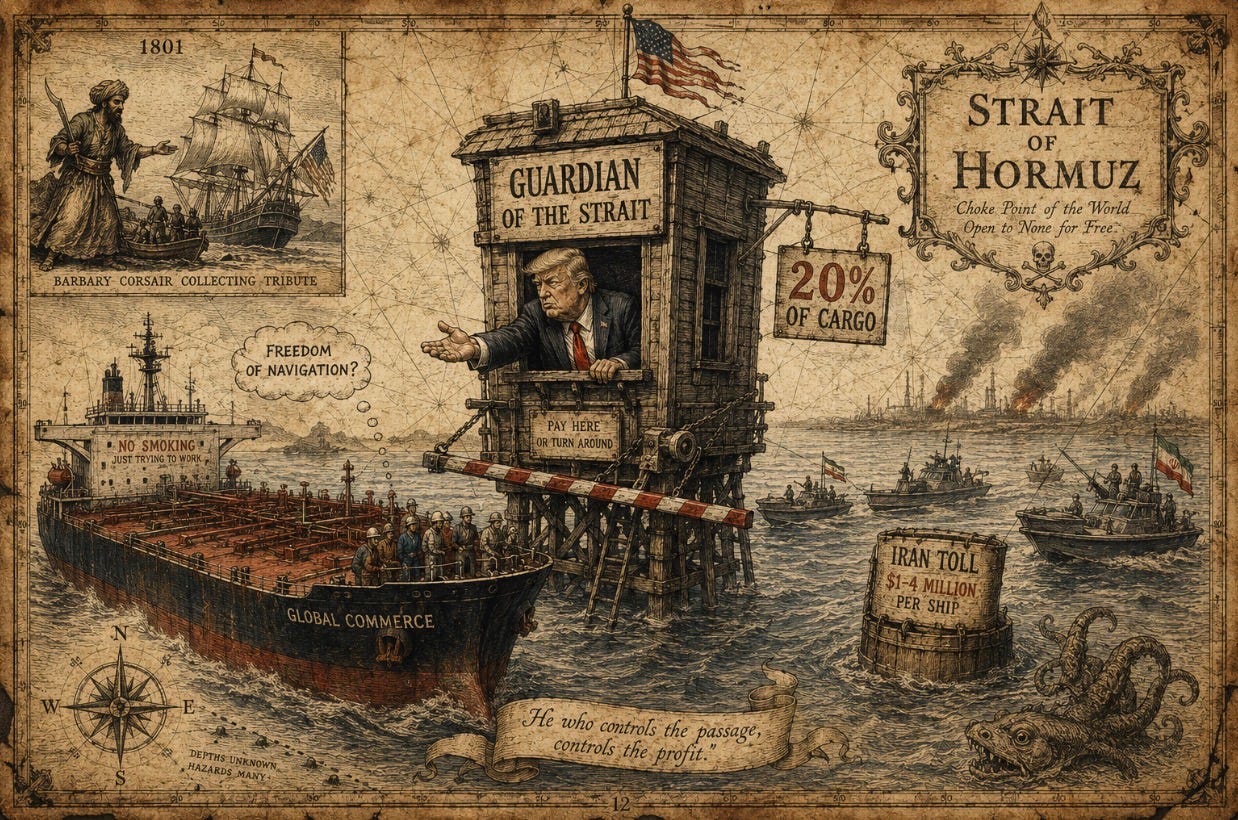
On July 13, President Donald Trump declared that the Strait was “OPEN” and would remain open “with or without Iran.” In the same announcement, he proclaimed the United States the “GUARDIAN OF THE HORMUZ STRAIT,” reinstated a naval blockade of Iranian ports and demanded reimbursement equal to 20 percent of the value of all cargo shipped through the waterway. The Strait was open, he insisted, but dangerous enough to justify a fee that would have cost roughly $32 million to $34 million for a single loaded supertanker. The United States controlled the danger, he suggested, although the danger remained severe enough to require payment on a scale usually associated with confiscation.
By the following day, the fee was gone.
Trump announced that “highly productive conversations with Middle East leadership” had persuaded him to replace the 20 percent charge with unspecified trade and investment deals from Gulf states. No countries were identified. No amounts were disclosed. No agreements were produced. The blockade, however, proceeded on schedule, supported by more than twenty American warships and hundreds of military aircraft operating across the region.
The sequence lasted barely twenty-four hours, but it contained the entire Trumpian theory of power. Announce control over something not controlled. Demand an extravagant payment no one has accepted. Encounter resistance. Retreat from the original demand. Rename the retreat a superior arrangement. Then move quickly enough that the public is invited to remember only the posture, never the result.
This would be merely ridiculous if the subject were not one of the most dangerous waterways on Earth.
Before the war, somewhere between one-fifth and one-quarter of the world’s seaborne oil passed through the Strait of Hormuz, along with roughly one-fifth of global liquefied natural gas. Depending upon the counting method, normal traffic amounted to approximately one hundred or more vessel transits each day. Kpler counted 147 vessels the day before the war began. On Sunday, July 12, it counted fourteen, only four of them crude tankers.
The Strait is therefore not closed in the absolute sense. Ships still pass. Some travel with their transponders switched off. Alternative routes along Oman remain physically available. The United States Department of Energy reported that 8.5 million barrels moved through on July 12 despite the fighting. Legally, the waterway remains an international strait through which transit passage cannot simply be suspended at the preference of either coastal state.
But it is not open in any commercially normal meaning of the word.
A waterway is not open merely because a ship can force its way through it. It is open when captains are willing to sail, crews are willing to board and insurers will underwrite the voyage without treating every transit as a wager against missiles, mines and fire. It is open when cargo schedules can be trusted, freight rates remain sustainable and commercial passage no longer depends upon whether a vessel uses an Iranian-approved route, an American-protected route or darkness itself as camouflage.
Hormuz satisfies none of those conditions. It is legally open, physically passable in reduced numbers, militarily contested and commercially crippled. Trump’s capital letters do not resolve the distinction. They merely conceal it.
The commercial world has understood what the White House refuses to admit. Major carriers suspended transits soon after the war began. War-risk premiums multiplied. Ships accumulated inside the Gulf. By late April, the International Maritime Organization estimated that roughly 2,000 vessels and 20,000 mariners were stranded. Marco Rubio later placed the number of people aboard trapped ships at approximately 23,000 from eighty-seven countries and acknowledged that at least ten civilian sailors had been killed. Tankers altered course. Some operators paid for alternative arrangements. Others waited. The Strait remained a place where traffic was possible but confidence was not.
That is what makes Trump’s proclamation so revealing. He did not restore commercial confidence and then announce the result. He announced the result because restoring commercial confidence had proved difficult.
The war itself began on February 28, when the United States and Israel launched coordinated strikes against Iran while nuclear negotiations were still in progress. The opening attack killed Supreme Leader Ali Khamenei. Iran retaliated across the region and moved to disrupt Hormuz through warnings, boardings, ship attacks and mines. Within days, traffic had fallen toward zero. American military officials had reportedly warned Trump in advance that Iran might respond by closing or crippling the Strait. He proceeded anyway, convinced that Iran would capitulate and that American force could reopen the waterway if necessary.
Five months later, the United States had struck thousands of targets, imposed two naval blockades, deployed an extraordinary concentration of naval and air power, and repeatedly announced success. Normal commercial passage had still not returned.
There is no cleaner measurement of the distance between force and strategy.
American forces can destroy radar sites, missile batteries, small boats and command facilities. They can punish Iran for attacking a tanker. They can degrade coastal defenses and intercept drones. What they cannot do easily is eliminate every mobile launcher hidden across hundreds of miles of coastline, guarantee that no mine remains in the water, or persuade a private shipping firm that the next threat over marine radio is a bluff.
Iran does not need to sink every ship. It does not need to win a naval battle. It needs only to preserve enough uncertainty that owners, crews and insurers decide the voyage is not worth the risk. A missile does not have to strike a tanker to alter commerce. It only has to make the next tanker hesitate.
Experts who have examined the problem describe what actual control would require. A large share of the United States fleet would need to remain committed indefinitely. Convoys would have to be escorted. Mines would have to be cleared and kept cleared. Shore-based missile and drone sites would have to be found before they moved. Some analysts have concluded that the Strait could not be made reliably safe without ground forces occupying significant parts of Iran’s coastline, an operation requiring tens of thousands of troops and exposing them to the kind of insurgency Iran has spent decades preparing to wage.
Trump’s promise that the Strait will remain open forever is therefore not strategy. It is an incantation uttered against geography.
Forever is not an operational term. It does not specify the required ships, the acceptable casualties, the political objective or the conditions under which the commitment ends. It belongs to advertising, marriage vows and political theater. In military affairs, it usually means that no one has thought seriously about next month.
The administration has attempted to disguise that absence of strategy with a succession of cease-fires, memoranda and declarations of victory. None produced a durable end to the fighting.
The first cease-fire began on April 8 and immediately strained under the weight of unresolved disputes. Israel continued military operations in Lebanon. Iran refused to reopen Hormuz on American terms. Talks failed. The United States imposed a blockade of Iranian ports beginning April 13.
On May 5, Rubio announced that Operation Epic Fury had concluded and that the United States had achieved its objectives. The original public rationale had centered upon preventing Iran from obtaining a nuclear weapon. The definition of success now shifted toward destroying the ballistic-missile “conventional shield” protecting Iran’s nuclear program. Enriched uranium remained unsecured. The Strait remained obstructed. A separate maritime operation continued because the principal economic consequence of the war had not been resolved.
Victory had been declared by redefining what victory meant.
A second framework emerged in June. Trump and Iranian President Masoud Pezeshkian signed a fourteen-point memorandum intended to create sixty days of reduced hostilities. The available record indicates that it provided for toll-free passage through Hormuz, removal of the American blockade, sanctions relief and negotiations over the future administration of the waterway. It also purported to end hostilities on all fronts, including Lebanon.
The agreement never became peace.
Israel continued operations in southern Lebanon. Iran called those attacks violations and again declared the Strait closed. A commercial ship was attacked. The United States struck Iranian targets. Iran retaliated against bases hosting American forces. Another agreement to stop exchanging attacks followed on June 28. It lasted roughly a week before commercial vessels were struck again and American attacks resumed.
On July 8, Trump declared the memorandum “over.”
To say that the cease-fire collapsed gives too much solidity to what existed. It did not fall like a bridge that had once been standing. It was an interim structure laid across a war that never stopped moving beneath it. Bombs continued to fall, shipping remained threatened and the central political dispute was deferred rather than settled. The language of peace arrived well before the substance.
This has become one of the defining habits of Trumpian government. The administration does not merely exaggerate its successes. It attempts to establish them by proclamation. A negotiation becomes a deal before the terms are known. A pause becomes peace before the firing stops. A waterway becomes open before normal commerce returns. When reality objects, the declaration is not reconsidered. It is repeated more loudly.
Geography cannot be bullied into agreement.
Neither can international law. On June 24, Rubio stated that Iran would not be permitted to charge tolls or fees through Hormuz. The next day, in Bahrain, he declared that international waterways “do not belong to any nation-state.” The United States had signed an interim agreement requiring toll-free passage for sixty days. The position was clear: Iran could not convert its ability to threaten shipping into a right to collect payment.
Less than three weeks later, Trump proposed doing exactly that himself.
The hypocrisy is obvious, but hypocrisy is not the most important point. Governments violate their own principles with depressing regularity. What matters here is how quickly the principle disappeared once Trump imagined himself collecting the money. A mandatory Iranian fee was unlawful extortion. A vastly larger American fee became fairness. The legal argument did not change. The identity of the proposed toll collector did.
The International Maritime Organization responded that there was no legal basis for mandatory tolls simply to transit an international strait. Brazilian President Luiz Inácio Lula da Silva used a less technical term. “This used to be considered piracy,” he said.
Iranian Foreign Minister Abbas Araghchi understood the opening Trump had provided. If those who ensure safe passage deserve compensation, he replied, then Iran could claim the same principle. Twenty percent was excessive, he added. Iran would be fair.
The mockery landed because Trump had demolished his own country’s position. For months, Washington had insisted that Hormuz could not be treated as the private possession of the state capable of threatening it. Trump then declared the United States its guardian and proposed a charge much larger than the fee Iran had reportedly extracted during the war. In doing so, he did not defeat Iran’s argument. He legitimized it.
The distinction between protecting commerce and monetizing insecurity is older than the modern state. Maritime empires have always understood that control of the sea can be converted into wealth. Athens built the Delian League as a system of collective defense against Persia, funded through contributions from its members. Over time, the alliance hardened into empire. Contributions became tribute. States that attempted to leave discovered that protection was no longer voluntary and membership no longer negotiable.
The transformation was not completed when Athens began collecting money. Collective defense requires resources. It was completed when dependency itself became the justification for compulsion.
The early United States encountered a cruder version in the Mediterranean. The Barbary states demanded payment and tribute in exchange for leaving American shipping unmolested. The seller of protection was also the source of the danger. The young republic eventually built a navy and fought rather than accept that arrangement permanently.
More than a century later, the United States Navy escorted reflagged Kuwaiti tankers through this very same waterway during the Iran-Iraq War. Operation Earnest Will was dangerous and compromised. American sailors died. The USS Samuel B. Roberts struck an Iranian mine. The United States destroyed much of Iran’s naval capacity in Operation Praying Mantis. An American cruiser later shot down Iran Air Flight 655, killing 290 civilians, one of the ugliest consequences of a policy often remembered too cleanly.
America was not acting from charity. It sought to contain Iran, block Soviet influence, support Gulf allies and preserve the oil system upon which its own power depended. The United States has never protected the seas out of disinterested benevolence.
That concession matters because the alternative is mythology.
Yet Operation Earnest Will was still grounded in a strategic proposition. Freedom of navigation was treated as a public good because the dominant naval power benefited from an international system in which commercial passage remained open. The service was not offered in exchange for one-fifth of the cargo. The security of the route was understood as part of the architecture of American power, not as an invoice waiting to be sent.
Trump looked at the same water and saw an uncollected fee.
That is his innovation. It is not self-interest. Every state acts from self-interest. It is the reduction of national interest to immediate extraction, as though the value of an alliance, institution or security guarantee can be measured only by the payment collected at the point of service. NATO becomes a delinquent account. Foreign aid becomes wasted inventory. Tariffs become instruments for every grievance. A naval commitment becomes a subscription plan.
His defenders call this transactional foreign policy, a phrase that gives calculation far too much credit. Transactionalism implies that objectives have been identified, costs measured and leverage applied toward a defined result. What Trump practices is more primitive. The demand comes first. The implementation is someone else’s problem. The reaction is discovered in public. When the demand fails, another demand replaces it and the replacement is called victory.
At Hormuz, the strategic objective has migrated so often that the migration itself has become the policy. The war was launched to prevent a nuclear weapon. It became a campaign to destroy Iran’s conventional shield. It became an operation to reopen the Strait, enforce a blockade, compel negotiations, prevent Iranian tolls, establish American control, collect an American toll and secure investment from Gulf monarchies. Each new objective explains the previous action only after the previous explanation has become inconvenient.
A military operation without a stable political objective does not become strategy merely because the explosions are real.
This is the question every serious government must answer before using force: what political world is the force intended to create? It is not enough to identify the target. One must identify the settlement. What must Iran agree to? What must the United States accept? Who administers the Strait? What happens to the nuclear program? What ends the blockade? What obligations bind Israel? What happens in Lebanon? What conditions allow American forces to leave?
The administration has offered no durable answer because the answer changes with the latest proclamation.
This is where the distinction between power and statecraft becomes unavoidable. Power can destroy a missile battery. Statecraft determines whether its destruction brings the desired settlement closer. Power can blockade a port. Statecraft calculates whether the blockade strengthens the negotiating position or guarantees retaliation. Power can frighten an adversary. Statecraft understands what the adversary fears, what it values and what it will endure before surrendering.
The United States does not lack power.
It lacks wisdom at the desk where power is presently being converted into action.
Strength cannot cure ignorance.
It can conceal ignorance for a time. It can drown uncertainty beneath the noise of aircraft and missiles. It can punish anyone who exposes the gap between a boast and the world as it exists. But strength cannot teach a government what it refuses to learn. It cannot transform changing objectives into strategy, improvisation into diplomacy or coercion into legitimacy. It can only make the consequences of ignorance larger, bloodier and more expensive.
The cost has already been paid by people who never participated in Trump’s performance. Iranian civilians killed in the opening assault. Sailors trapped aboard commercial vessels. Crews struck by missiles while carrying cargo for states that were not parties to the war. American servicemembers ordered into an open-ended confrontation whose definition of victory changes by the week. Families across the region living beneath alarms and interception systems while political leaders announce peace between rounds of attack.
Those costs disappear when policy is described as theater. The president flexes. The adversary responds. The market moves. The fee is withdrawn. The headline changes. But people remain dead, ships remain endangered and the political settlement remains as distant as before.
This is what makes the performance embarrassing rather than merely incoherent. The United States possesses extraordinary diplomatic reach. It has intelligence agencies that understand Iran’s military structure, allies with direct stakes in the region and naval officers who know precisely how difficult Hormuz is to secure. It has decades of experience with the costs of confusing battlefield superiority with political success.
Trump treats that accumulated knowledge as an impediment to instinct.
He prefers the boast because the boast asks nothing of him. Diplomacy demands patience, history imposes humility and strategy requires the admission that force has limits. A declaration requires only a platform and an audience willing to mistake certainty for competence.
The Strait of Hormuz has exposed that fraud because it refuses to behave like a rally crowd. Ships do not applaud. Insurers do not fear social-media abuse. Mines do not care who won the news cycle. Iran’s coastline remains where it was before the first bomb fell, and every concealed launcher is a reminder that geography grants vetoes even to weaker states.
Trump can call himself the guardian. He cannot guarantee the guardianship.
He can declare the Strait open. He cannot make commerce normal.
He can demand twenty percent. He cannot explain by what law, mechanism or consent it would be collected.
He can abandon the fee and announce investment deals. He cannot produce agreements that have not been made.
What remains after the declarations is the record: a war entered with warning, a waterway still disrupted, a cease-fire that never fully stopped the fire, a legal principle discarded when tribute appeared available, and a toll withdrawn almost as quickly as it was announced.
The protection racket does not require that the bully create every danger. It requires only that he help intensify the danger, claim exclusive power to manage it and demand payment from those trapped by the consequences.
That is what happened at Hormuz.
He helped ignite the fire, blocked the exits, and then offered protection for a price. History has never mistaken that arrangement for leadership.
Neither should we.
One last thing.
Most of my longer investigative work now appears through my role as a writer and editor at Aebly Media. We’re trying to build the kind of newsroom I wish existed more often: one that slows down, follows the evidence, values history, and isn’t afraid of complexity.
If today’s essay resonated with you, I think you’ll find plenty more there.
Take a look around. Read a few stories. Challenge us when you disagree. Good journalism should invite conversation, not demand obedience.
Aebly Media is still growing, but I genuinely believe it’s becoming one of the more interesting independent newsrooms around.
I’d love for you to be part of that journey.
https://aeblymedia.com